
water Catchment and storage
catch it, clean it, store it, distribute as needed.
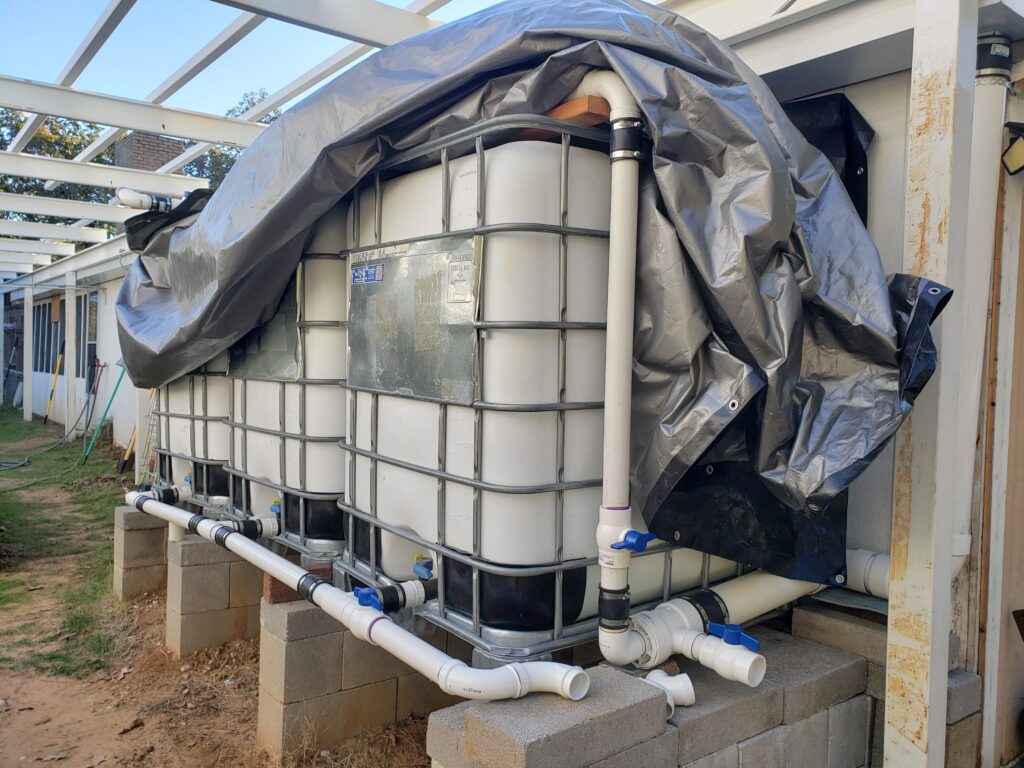
For potable water storage, we purchased three 330-gallon metal-framed water totes from BiLo. Rain catchment storage starts with the kind of roof you’re catching the rain from. Asphalt shingle roofs deliver carcinogens along with the rainwater. Metal roofs and greenhouse roofs don’t deliver those kinds of carcinogens. Rain from asphalt roofs can be used for flushing toilets but little else. All rainwater requires some level of filtration. Our filtration system is gravity powered and requires little maintenance.
Storage is one thing, but easy filtration is everything. If it’s not easy, you won’t do it. We elevated the totes up to the point where they can gravity-feed the gardens and toilets. The metal roof rain gutter pours into a 4″ PVC pipe that turns horizontal at the bottom. Debris either floats in the 4″ down tube or accumulates in the bottom section. Opening a valve there turns it all into a simple downspout that flushes the debris out. Leaving the valve closed causes the water level to rise up a 2″ vertical pipe and distribute to the three water totes. The outbound valves of the totes are then connected to a manifold pipe for distribution.
We don’t use any automation for watering yet, but will once the overall system is worthy of that project.
Stay tuned, homesteaders!
From Roof to Root Zone
We also purchased two 300-gallon black plastic tanks for non-potable water storage. One collects rain from the shingled house for toilet flushing, and the other is where we pump duck pond water for distribution. We water our olive and fig tree with fertile water from the duck pond and watch them grow, baby, grow. Future plans include a line of trees, orange, lemon, pecan and more.
When the pond water tank is full, overflow is returned to the pond just a bit cleaner. Each time you move pond water, some of the debris sinks to the bottom, making each vessel a pre-filter of sorts. The pond itself is a pre-filter, and we dump and rinse it out every three or four days into barn straw dump to create fertilizer.